Your customer just placed an order. You send them a thank-you message with an offer for 20% off their next purchase — through your transactional SMS route. Sound familiar?
That is a compliance violation — and it happens more often than you would think.
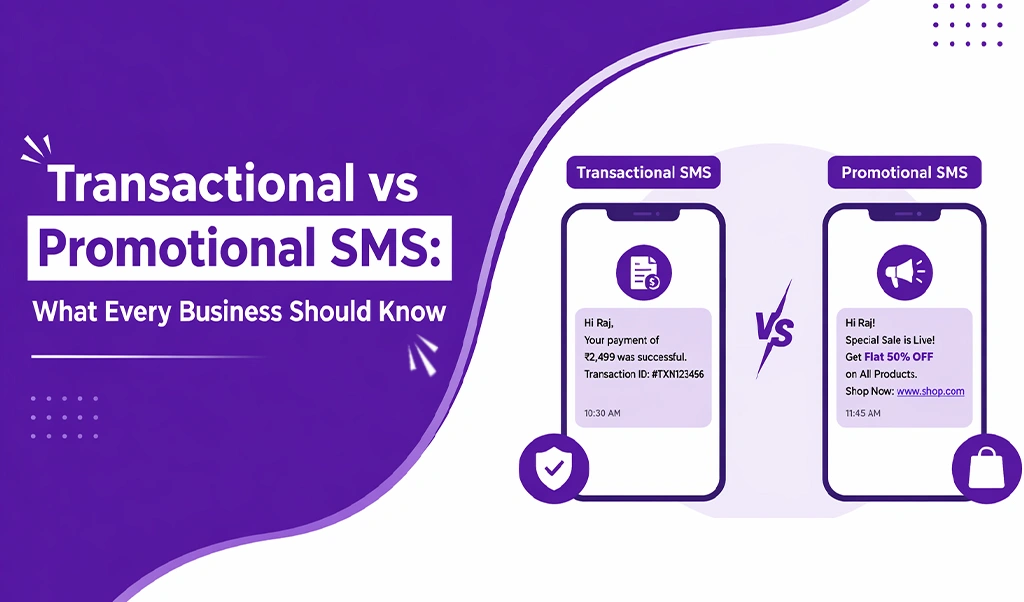
- Transactional vs promotional SMS is one of the most misunderstood topics in Indian business communication. Both are SMS. Both reach the same phone. But TRAI (Telecom Regulatory Authority of India) treats them very differently — and confusing the two has real consequences.
According to TRAI’s Telecom Commercial Communications Customer Preference Regulations (TCCCPR) 2018, misuse of transactional routes for promotional content can result in sender ID blacklisting and fines.
This guide breaks down the differences clearly — so your business communicates smarter, stays compliant, and gets better results from every message you send.
What Are Transactional and Promotional SMS — and Why Should Businesses Care?
Let’s define both clearly before comparing:
Transactional SMS
SMS sent to customers as part of a service or transaction they have already initiated or agreed to.
- Examples: OTPs, bank alerts, order confirmations, appointment reminders, delivery updates, password resets.
- Key characteristic: The message is information the customer needs — not content the business wants them to see.
- TRAI rule: Can be sent 24/7 — including to numbers on the DND (Do Not Disturb) registry.
Promotional SMS
SMS sent to promote a product, service, offer, or brand — typically to potential or existing customers.
- Examples: Sale announcements, discount offers, new product launches, event invitations, loyalty reward alerts.
- Key characteristic: The message is the content the business wants to send — not a response to a customer action.
- TRAI rule: Cannot be sent to DND-registered numbers. Restricted to a 9 AM–9 PM delivery window.
In Simple terms, Transactional SMS is a receipt. Promotional SMS is a flyer. Both arrive in the same inbox, but one was asked for, and one was not.
What Are the Key Differences Between Transactional and Promotional SMS?
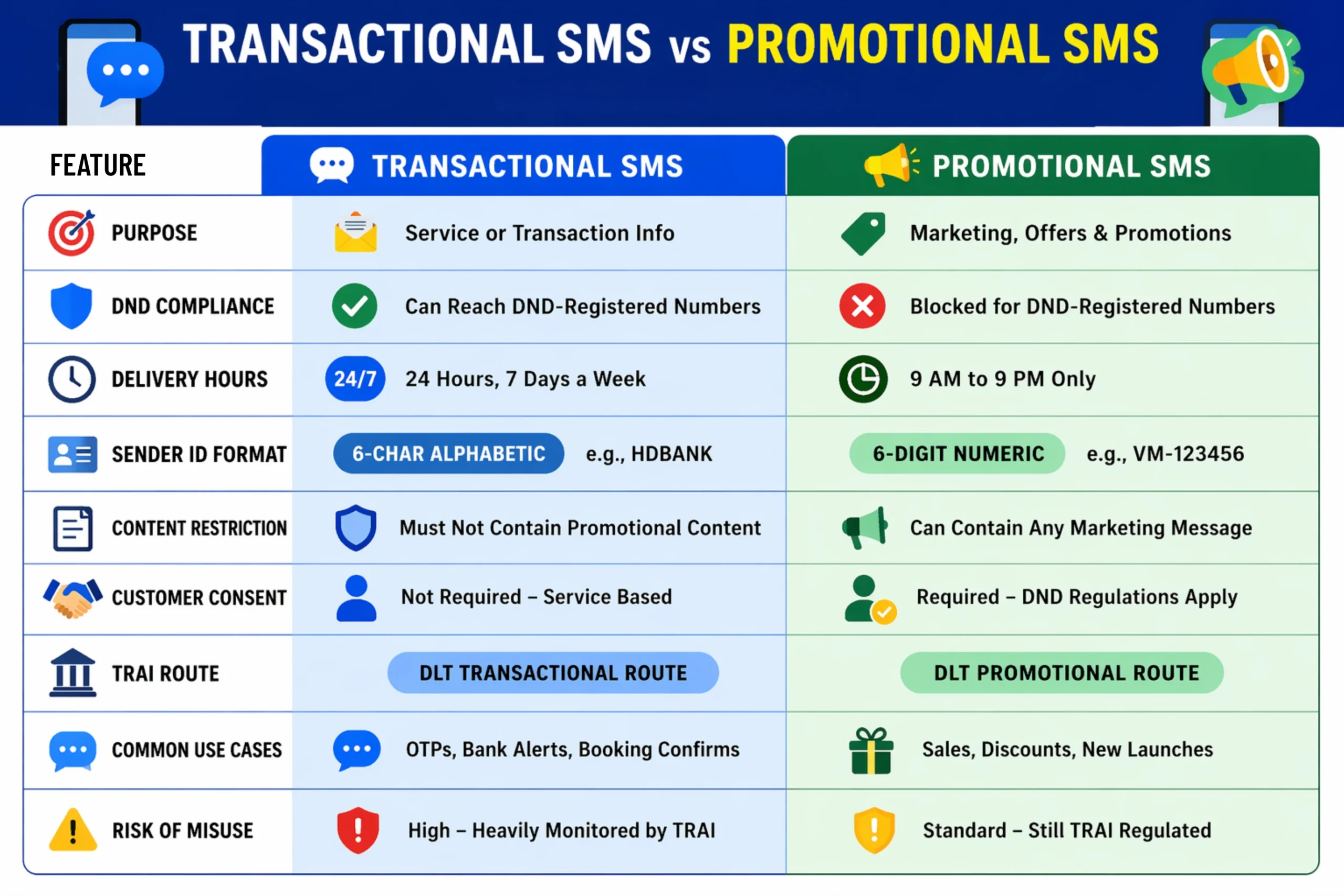
Here is where most businesses go wrong: they treat these as interchangeable. They are not.
|
Feature |
Transactional SMS |
Promotional SMS |
|
Purpose |
Service or transaction-related information |
Marketing, offers, and promotions |
|
DND Compliance |
Can reach DND-registered numbers |
Blocked for DND-registered numbers |
|
Delivery Hours |
24 hours, 7 days a week |
9 AM to 9 PM only |
|
Sender ID Format |
6-character alphabetic (e.g., HDBANK) |
6-digit numeric (e.g., VM-123456) |
|
Content Restriction |
Must not contain promotional content |
Can contain any marketing message |
|
Customer Consent |
Not required — service-based |
Required — DND regulations apply |
|
TRAI Route |
DLT Transactional Route |
DLT Promotional Route |
|
Common Use Cases |
OTPs, bank alerts, booking confirms |
Sales, discounts, new launches |
|
Risk of Misuse |
High — heavily monitored by TRAI |
Standard — still TRAI regulated |
Key takeaway: The moment a transactional SMS contains promotional content — an offer, an upsell, a discount it becomes promotional under TRAI rules, regardless of which route it was sent on.
What Are the TRAI Rules Indian Businesses Must Follow for SMS?
India’s SMS landscape is governed by TRAI’s TCCCPR 2018 — the Telecom Commercial Communications Customer Preference Regulations. Non-compliance is not just a financial risk; it damages your sender ID reputation and customer relationships.
Rules for Transactional SMS
- Must relate directly to a service or transaction the customer engaged with
- Cannot include promotional content — no offers, no upsells, no discounts
- Must use a 6-character alphabetic Sender ID registered on the DLT platform
- Template must be pre-approved and registered on the DLT (Distributed Ledger Technology) system
- Delivery allowed 24/7 — including to DND numbers
Rules for Promotional SMS
- Must use a 6-digit numeric Sender ID — not an alphabetic brand name
- Cannot be sent to numbers on the DND registry (over 230 million registered numbers in India)
- Can only be delivered between 9:00 AM and 9:00 PM
- The template must be DLT-registered and approved before sending
- Opt-out mechanism required — customers must be able to unsubscribe
According to TRAI data (2023), over 230 million Indian mobile numbers are registered on the DND registry — meaning a significant portion of your customer base may be unreachable via promotional SMS.
|
💡 valueoneai Compliance Note
|
When Should a Business Use Transactional SMS vs Promotional SMS?

Choosing the right SMS type for each communication is both a compliance requirement and a strategy decision. Here is a quick decision guide:
Use Transactional SMS When…
- A customer just made a purchase — send the order confirmation immediately
- A payment was processed — send the transaction receipt
- A customer is logging in — send the OTP
- A delivery is out for dispatch — send the tracking update
- An appointment is tomorrow — send the reminder
- A password reset was requested — send the verification link
Use Promotional SMS When…
- You are running a seasonal sale — Diwali, New Year, summer offer
- You have a new product or service launch
- You want to re-engage lapsed customers with a comeback offer
- You are running a referral programme — invite-a-friend campaigns
- You want to promote a flash sale or limited-time discount
- You are announcing an event, webinar, or in-store promotion
The Grey Zone — Watch Out for These
Post-purchase upsell in an order confirmation: Transactional content only — add the offer, and it becomes promotional.
Birthday greetings with a discount coupon: The greeting is okay; the coupon makes it promotional.
Delivery confirmation with ‘Shop Again’ link: Promotional content — use the promotional route.
Account alert with a product recommendation: The alert is transactional; the recommendation is not.
What Are the Best Practices for Each SMS Type in India?
Knowing the difference is step one. Executing both well is step two. Here is what works:
Transactional SMS Best Practices
- Be specific: Include the exact details — amount, order ID, appointment time. Vague confirmations frustrate customers.
- Be fast: Transactional SMS should arrive within seconds of the trigger event. Delayed OTPs kill conversions.
- Keep it short: 160 characters max when possible. Long transactional SMS risk being split or delayed.
- Include a reference number: Customers need to cross-reference their confirmation — always include it.
- Do not add offers: Resist the temptation. One promotional line = TRAI violation.
Promotional SMS Best Practices
- Lead with the offer: State the benefit in the first line. ‘Save 30% today’ beats ‘We are pleased to inform you of a limited-time offer’.
- Create urgency: ‘Valid till midnight’, ‘Only 50 left’, ‘Offer ends Sunday’ — time limits drive action.
- Include a clear CTA: Tell the customer exactly what to do — Visit link, Call now, Reply OFFER, Show this SMS.
- Send at the right time: 12–2 PM and 6–8 PM consistently outperform other sending windows for promotional SMS in India.
- Personalise where possible: ‘Hi Priya, your 20% off coupon is ready’ outperforms ‘Dear Customer’ every single time.
How Do You Choose the Right SMS Strategy for Your Business?
Most Indian businesses need both SMS types — but in different proportions depending on their industry and customer journey. Here is how to think about your mix:
SMS Strategy by Business Type
- E-commerce businesses: Heavy transactional (order, dispatch, delivery) + moderate promotional (cart recovery, sale campaigns).
- Banks and fintech: Almost entirely transactional — OTPs, alerts, statements, fraud notifications.
- Retail and D2C brands: Balanced mix — loyalty updates (transactional) + offer campaigns (promotional).
- Healthcare and clinics: Predominantly transactional — appointment reminders, lab results, follow-up prompts.
- Ed-tech and coaching: Mixed — class reminders (transactional) + new course launches (promotional).
- Travel and hospitality: Heavy transactional — bookings, check-in reminders + promotional for off-season offers.
Are You Ready to Move Fast in 2026 with Smart Bulk SMS?
If your business wants faster customer interactions, stronger engagement, and better responses to time-sensitive updates, now is the time to invest in a reliable strategy with a trusted bulk SMS provider in Delhi, result-driven bulk SMS service in Jaipur, and scalable bulk SMS solutions in Hyderabad to reach your audience effectively across India.
Get a Demo →At a Glance: Transactional vs Promotional SMS for Indian Businesses
|
Transactional SMS |
Promotional SMS |
|
|
Best For |
OTPs, alerts, order updates, reminders |
Sales, offers, launches, campaigns |
|
Sender ID |
6-char alphabetic (e.g., HDBANK) |
6-digit numeric (e.g., 123456) |
|
DND Numbers |
Can reach — no restriction |
Blocked — cannot reach DND numbers |
|
Delivery Window |
24/7 — any hour, any day |
9 AM – 9 PM only |
|
Customer Consent |
Not required |
Required per TRAI |
|
Content Type |
Information only — no promotional content |
Marketing content allowed |
|
DLT Registration |
Mandatory |
Mandatory |
|
Risk of Violation |
High if promotional content is included |
Standard TRAI regulations |
|
Best Sending Time |
Immediately — triggered by the event |
12–2 PM or 6–8 PM for best response |
|
Used By |
Banks, e-commerce, healthcare, fintech |
Retail, D2C, hospitality, ed-tech |
Expert Tips from valueoneai
1: Register Your DLT Templates Before You Need Them
Never plan a campaign and then register the template — plan the template first, then plan the campaign.
2: Segment Your Audience Before Every Promotional Campaign
Targeted SMS consistently outperforms broadcast — fewer messages, higher conversion, lower opt-out rate.
3: Treat Your Transactional SMS as a Brand Touchpoint
You cannot add promotional content — but you can reinforce your brand tone: ‘Your order #12345 is on its way! Thanks for choosing [Brand].’
4: Monitor Delivery Reports — Always
Low delivery rates on promotional SMS often indicate a high DND proportion in your list.
Low delivery on transactional SMS is a serious problem, as it means customers are not receiving critical information.
Common Mistakes Businesses Make With SMS
1: Using the Transactional Route for Promotional Content
This is a TRAI violation — regardless of how small the promotional element is. One discount code in an order confirmation SMS = misuse of the transactional route. Instead, keep transactional SMS purely informational.
2: Sending Promotional SMS to Your Entire Database
A large portion of Indian mobile users are DND-registered. Sending to the full list wastes budget and generates failed delivery reports. Instead, filter your list for DND numbers before every promotional campaign.
3: Not Registering Templates on DLT
Since TRAI’s TCCCPR 2018 enforcement, unregistered SMS templates are blocked by telecom operators before reaching the recipient. Your messages simply do not arrive. Instead, every SMS template — transactional or promotional — must be registered and approved on the TRAI DLT platform before sending.
4: Sending Promotional SMS at the Wrong Time
Promotional SMS sent outside 9 AM–9 PM are blocked by the network. Additionally, sending at 9 AM sharp reaches customers mid-commute — not ideal for retail offers. Instead, schedule promotional SMS.
Conclusion
SMS is one of the highest-reach communication channels in India — but only when used correctly. Getting the transactional vs promotional distinction right is not just a compliance checkbox — it is the foundation of an SMS strategy that customers trust and respond to. Misuse the routes, and you risk blocked messages, blacklisted sender IDs, and customer frustration. Get it right, and you have a 24/7 communication channel with near-100% reach, instant delivery, and measurable response.