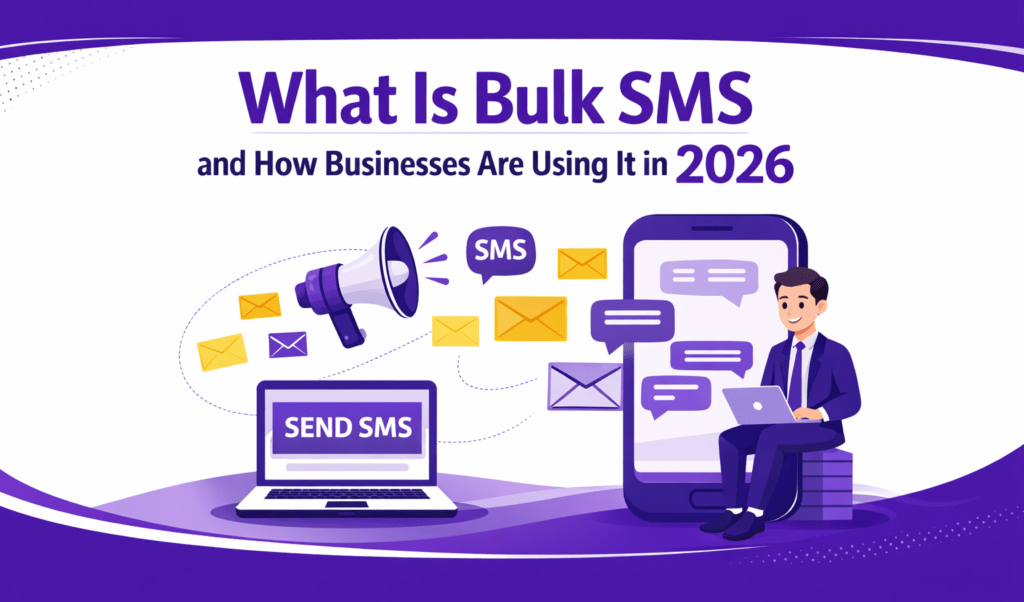
In 2026, bulk SMS remains the most effective method for businesses to connect with their customers. The direct and speedy nature of SMS, which works on all mobile devices, remains an essential communication method for brands that now use WhatsApp, email, and apps together with RCS.
Industry and platform sources still position SMS as a core channel for OTPs, alerts, reminders, and fast promotional communication, especially for time-sensitive messages.
The bulk SMS service in India has evolved beyond its original function, which allowed businesses to send mass marketing messages. The system now serves as a formal communication platform which enables businesses to handle customer identity verification, provide order status updates, send payment notifications, confirm appointments, deliver service messages, and execute marketing campaigns.
Indian businesses must implement proper SMS usage because the country enforces strict DLT requirements and consent-based compliance regulations. The combination of instant communication across multiple devices without requiring users to access an application makes bulk SMS essential for your marketing and customer communication strategies.
Businesses continue to use this system because it provides essential services which they require in 2026.
What Is Bulk SMS?
Bulk SMS means sending a large number of text messages to a selected group of recipients at the same time. The system operates through application-to-person messaging, which businesses use to send customers operational and promotional messages. Businesses use bulk SMS to send one message to hundreds or thousands or even lakhs of people with only one click or through API integration.
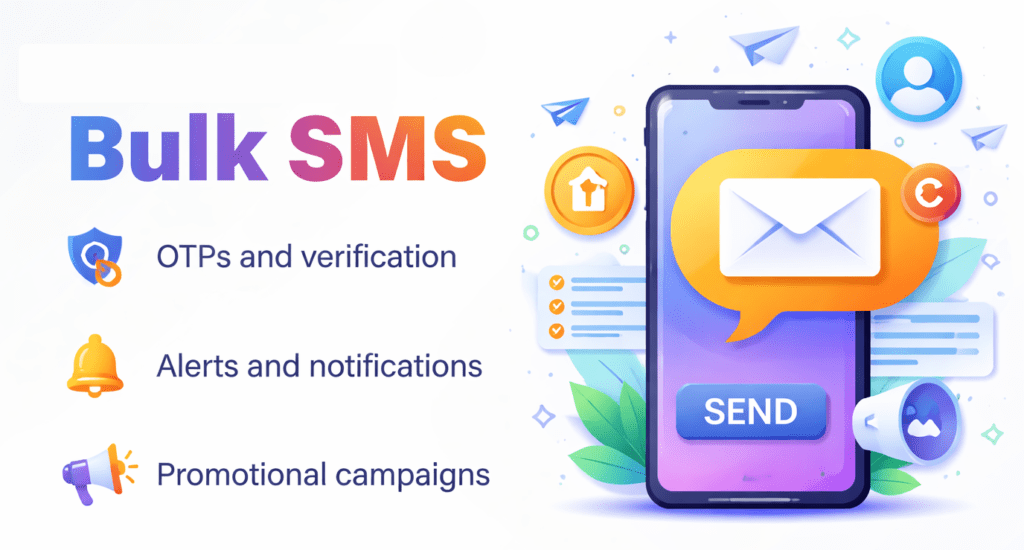
It is commonly used for:
OTPs and verification | Banks, apps, and online platforms use SMS to send one-time passwords for logins, sign-ups, and transactions. |
Alerts and notifications | Businesses use SMS for order updates, delivery status, appointment reminders, payment alerts, and service messages. |
Promotional campaigns | Retailers, e-commerce brands, coaching institutes, hospitals, travel companies, and local businesses use SMS to promote offers, launches, events, and limited-period deals. |
How Bulk SMS Works for Businesses
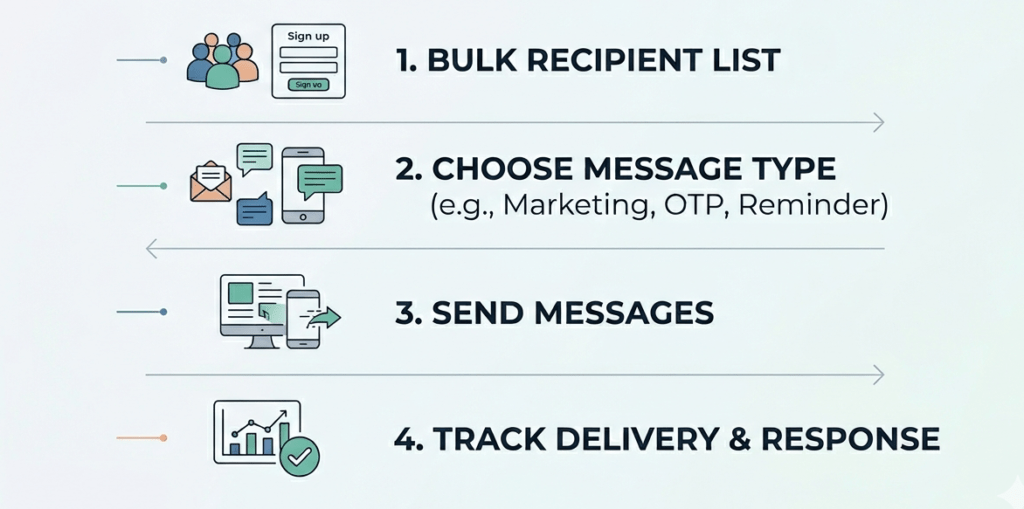
The process of sending bulk SMS messages uses either an SMS gateway or an SMS API as its primary method. A business either logs into a dashboard to upload numbers and send campaigns, or connects its website, CRM, app, or ERP to an SMS platform so messages go out automatically. SMS APIs serve as the connection point that enables web applications to communicate with telecom carrier networks.
Step 1: The Business Creates a Recipient List
This may come from customer sign-ups, purchases, enquiries, appointment bookings, or registered users. Good platforms also support segmentation, so the same message is not sent to everyone.
Step 2: The Business Chooses the Message Type
Some messages are marketing-focused, such as sale alerts and festival offers. Others are service-focused, such as OTPs, invoice reminders, or delivery updates. In India, this distinction matters because commercial messaging rules and templates apply.
Step 3: The Message is Sent Through a Platform or Api
A business can send manually from a panel or automate messages through software integrations. This is why bulk SMS is popular with growing brands, SaaS companies, hospitals, schools, and online businesses.
Step 4: Delivery and Response Are Tracked
Modern SMS platforms offer delivery reports, reply tracking, analytics, and routing tools so businesses can monitor campaign performance and operational communication.
Why Bulk SMS Still Matters in 2026
The primary reason for this situation which exists between two parties who need to reach each other through SMS technology. SMS functions on all mobile devices because it needs no additional software, and users can receive messages when they do not use email or social platforms.
The system excels at delivering brief messages which need immediate response from receivers. The second factor which affects the situation requires us to work with better solutions. The business world needs some messages which require immediate delivery.
The audience must quickly process OTPs, fraud alerts, order confirmations, flight delays, and appointment reminders. SMS remains one of the strongest channels for this kind of communication. People use SMS because it has evolved to meet their current needs.
Ready to Grow Faster with Smart Bulk SMS in 2026?
If your business wants faster customer communication, stronger engagement, and better responses for time-sensitive updates, now is the right time to invest in a reliable strategy with a
trusted bulk SMS provider in Delhi,
result-driven bulk SMS service in Jaipur, and
scalable bulk SMS solutions in Hyderabad
to reach your audience effectively across India.
How Businesses Are Using Bulk SMS in 2026
Businesses across all existing sectors now utilize bulk SMS services to develop more effective targeted marketing campaigns. The focus is no longer only on mass promotions. Businesses now require customer-specific communication that delivers useful information at the appropriate time.
Platform and messaging guidance consistently point to OTPs, notifications, reminders, promotions, and service alerts as the leading business use cases.
1. e-commerce and retail
Online stores use bulk SMS for order confirmation, shipping updates, COD confirmation, flash sales, abandoned cart nudges, coupon codes, and festive promotions.
Example:
“Your order #45821 has been shipped and will arrive by Tuesday.”
Flat 20% off on summer wear today only. Use code SUM20.”
2. Banking and fintech
Banks, wallets, NBFCs, and fintech apps use SMS for OTPs, transaction alerts, EMI reminders, account activity notices, and fraud warnings. These are among the clearest and most important SMS use cases.
3. Healthcare and hospitals
Hospitals, clinics, labs, and diagnostic centres use SMS for appointment reminders, test readiness alerts, vaccination reminders, and follow-up communication.
Example:
“Reminder: Your appointment with Dr. Mehta is tomorrow at 11:30 AM.”
4. Education and coaching
Schools, colleges, edtech brands, and coaching institutes use SMS for admission alerts, fee reminders, class schedules, exam notices, attendance updates, and webinar invitations.
5. Logistics and travel
Courier companies, delivery brands, cab operators, airlines, and travel agencies use SMS for pickup alerts, delivery status, gate changes, trip reminders, and delay notifications. Twilio’s guidance specifically highlights delivery updates and flight delay information as strong SMS use cases.
6. Real estate and local service businesses
Real estate companies, salons, gyms, automobile workshops, and service brands use SMS for lead follow-ups, booking confirmations, service reminders, and limited-time offers.
In short, bulk SMS in 2026 is being used where communication must be fast, clear, and easy to act on.
Types of Bulk SMS Businesses Commonly Use
Promotional SMS
TRAI describes promotional messages as commercial communication sent without explicit consent from the intended recipient. In practical marketing language, these are sales-driven messages used for offers, launches, deals, and awareness campaigns.
Service or transactional SMS
TRAI describes service messages as messages sent with consent or through registered templates to facilitate or confirm a commercial transaction, or to share important product, safety, warranty, or security information. This category covers many business-critical updates.
OTP SMS
OTP SMS is widely used for authentication, sign-up verification, secure login, and transaction confirmation. For many businesses, this is the most sensitive and high-priority SMS traffic.
Reminder and alert SMS
These are messages for appointments, renewals, billing dates, deliveries, events, and service actions. They may not always feel promotional, but they are often the messages that customers value the most.
Bulk SMS in India: What Businesses Must Know
If your business sends bulk SMS in India, compliance is a major part of the process. Under TRAI’s framework and TCCCPR, senders using telecom resources for bulk communication must complete the required registration and template steps.
The official guidance lists Principal Entity registration, header assignment, content template registration, transmission of PE ID/header/content ID, consent template registration, where applicable, and consumer consent acquisition, where applicable.
TRAI’s TCCCPR framework is designed to protect consumers from unsolicited commercial communication while allowing businesses to message customers who have opted in or whose preferences allow those messages.
This means businesses should not think of bulk SMS as a random blast tool anymore. In India, it is a regulated business communication channel. If you want good delivery and long-term trust, compliance is not optional.
Best Practices for Better Bulk SMS Results
Sending bulk SMS or writing Bulk SMS in the proper format is never an issue until or unless you follow a few proven practices that give better results for bulk SMS.
Keep the message short and clear: SMS is not the place for long explanations. Get to the point fast.
Send messages with a clear purpose: Every SMS should answer one question. What should the customer do next?
Segment your audience: Do not send the same message to new leads, repeat customers, inactive users, and premium buyers.
Use personalization where possible: A first name, city, order number, renewal date, or appointment time can make the message feel more useful.
Match the channel to the message: Use SMS for urgent or simple actions. Use WhatsApp or email when you need richer content, longer explanations, or two-way conversations. SMS and richer channels now increasingly work together instead of competing head-on.
Respect consent and timing: This matters for both compliance and brand trust. Messages sent at the wrong time or to the wrong audience damage results quickly.
How to Choose the Right Bulk SMS Service Provider
A good bulk SMS provider should do more than just deliver messages. It should help your business send the right messages in the right format with the right compliance support. Look for:
DLT and compliance support: Especially important for India-based businesses.
Easy API integration: Useful for apps, websites, CRMs, ERPs, and automated workflows. SMS APIs are the standard way businesses connect software with carrier networks.
Strong delivery reporting: You should be able to track sent, delivered, failed, and response metrics.
Template and sender management: This helps reduce errors and improve campaign execution.
Scalability: Your provider should be able to handle growth during sale seasons, exams, festival campaigns, or high-traffic login periods.
Reliable support: When OTPs are delayed or campaigns fail, support speed matters.
Conclusion
The SMS service, which enables bulk messaging, remains operational in 2026 because it has developed into a superior system which provides businesses better functionality than they currently understand. SMS supports brands through its capability to deliver OTPs, service alerts and reminders and time-limited campaigns to customers with fast and clear communication.
The winning approach for Indian businesses requires them to implement bulk SMS through three essential components, which include proper strategic planning, customer segment identification and compliance management. The system functions as a messaging platform which businesses can use to connect with customers while achieving reliable growth.
Is bulk SMS legal in India?
Yes, but it must follow TRAI and TCCCPR rules. Businesses sending bulk communication need to complete the required sender, header, template, and consent steps where applicable.
Is bulk SMS the same as promotional SMS?
No. Promotional SMS is one category. Bulk SMS is the broader method of sending messages at scale, and it can include promotional, service, transactional, reminder, and OTP communication.
Why are businesses still using SMS in 2026?
Because it is direct, fast, app-free, and reliable for time-sensitive communication like OTPs, reminders, alerts, and quick offers.
Can small businesses use bulk SMS?
Yes. Bulk SMS is not only for large enterprises. Clinics, coaching centres, local retailers, service providers, and startups also use it for reminders, offers, and customer updates.
Does bulk SMS need internet on the customer’s phone?
No. One of SMS’s main strengths is that it works on mobile phones without needing a downloaded app or an internet-based messaging platform.
Is WhatsApp replacing bulk SMS?
Not completely. WhatsApp is strong for interactive conversations and rich media, but SMS still leads for urgent alerts, OTPs, wide device reach, and fallback delivery. In 2026, businesses are increasingly using both together.
What industries benefit the most from bulk SMS?
Frequently Asked Questions
e-commerce, healthcare, education, finance, logistics, travel, real estate, and local service businesses all benefit from bulk SMS.